

Applications of TPU materials in the automotive industry, check it out!
Date:2026-10-10TPU, short for Thermoplastic Polyurethanes, is a thermoplastic polyurethane elastomer formed by the block combination of urethane hard segments (reacting with isocyanates) and polyester or polyether soft segments. Its chemical structure has little to no cross-linking, and the molecules are basically linear, yet it possesses a certain degree of physical cross-linking. It is mainly divided into polyester-based and polyether-based types.

Figure: Segment structure of polyurethane TPU thermoplastic elastomer
TPU is a material containing the -NH-COO- gene in its molecules. Long-chain diol and isocyanate components form the soft segments, while short-chain diol and isocyanate components form the hard segments. Many properties of TPU plastics depend on the type of long-chain diol, and its hardness is adjusted by the proportion of the hard segments.
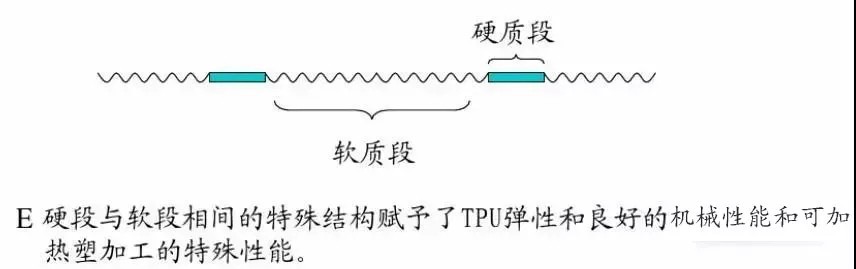
The special alternating structure of hard and soft segments endows TPU with elasticity, good mechanical properties, and the unique property of being thermoplastic processable.
Advantages of TPU thermoplastic elastomers
TPU has the following advantages compared to other thermoplastic elastomers:
(1)Excellent abrasion resistance: Its Taber abrasion value is 0.35-0.5mg, the lowest among plastics;
(2)Tensile strength and elongation: The tensile strength of TPU is 2-3 times that of natural rubber and synthetic rubber;
(3)Oil resistance: The oil resistance of TPU is superior to that of nitrile rubber, offering an excellent oil-resistant lifespan;
(4)Low-temperature resistance, weather resistance, and ozone resistance: The weather resistance of TPU is superior to that of natural rubber and other synthetic rubbers. Its ozone and radiation resistance make it suitable for special applications in the aerospace industry;
(5)Food, medical, and healthcareTPU is biocompatible and anti-thrombogenic, and its medical applications are becoming increasingly widespread, such as in catheters, ureteral stents, and infusion tubes. Meanwhile, TPU is free of reinforcing agents, non-toxic, and odorless, making it widely used in the food industry as well;
(6)Hardness range: The hardness of TPU ranges from 60A to 95A. It remains elastic even at hardness levels above 85A, a characteristic not found in other elastomers, which gives TPU high load-bearing capacity and excellent shock absorption and dissipation effects.
Applications of TPU Thermoplastic Elastomers
TPU features high strength, high wear resistance, high elasticity, aging resistance, and oil resistance, making it widely used in automotive components such as gear shift levers, shaft sleeves and washers for various couplings, connectors for various wire harnesses, spiral retractable wires, cable sheaths, toothed belts, steering rod sheaths and gaskets, suspension joint hinges, hydraulic and pneumatic components, suspension diaphragms, shock-absorbing diaphragms, shock absorbers, spring limit clips, etc. Due to its excellent performance, TPU has a very wide range of applications, including sports equipment, medical devices, industrial components, footwear materials, wires and cables, and more.
For example: Polyurethane (TPU) sheath material for charging pile cables, which is primarily made from TPU resin and mixed with additives such as eco-friendly or halogen-free flame retardants and antioxidants through compounding, plasticization, and granulation. It features flexibility, crush resistance, voltage resistance, high-temperature and pressure resistance, aging resistance, acid and alkali resistance, salt spray resistance, and waterproofing.
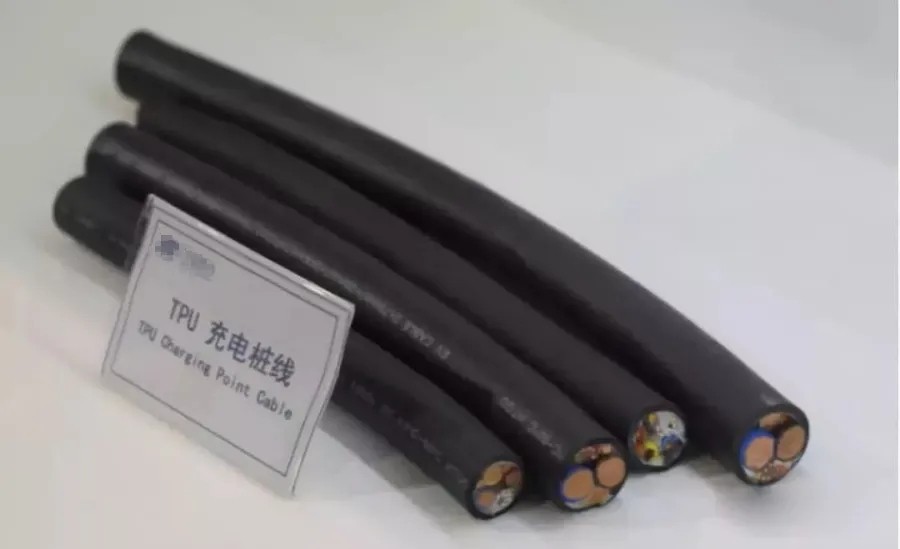
Application forms of TPU in the automotive field
1 TPU/PP plastic alloy
This material has advantages such as being lightweight, cost-effective, and recyclable, and is expected to be widely used in automotive interior and exterior parts, such as bumpers and their brackets, various brackets and structural frames on vehicles, etc.
2 TPU/PC plastic alloy
Blending TPU with PC can improve the toughness, stress cracking resistance, notch sensitivity, solvent resistance, and chemical resistance of PC, while reducing the molding and processing temperature of PC, thereby expanding its application scope in the automotive industry.
3 TPU/PVC plastic alloy
TPU/PVC alloys can significantly improve the elongation of PVC and greatly enhance its environmental friendliness, reducing the hazards caused by plasticizers in PVC to the environment and human health, thus expanding the application fields of PVC.
4 TPU/PA6 plastic alloy
The blending of TPU and PA6 not only retains the high elasticity, high strength, and wear resistance of TPU, but also improves its temperature resistance. With its outstanding comprehensive properties, it is a new type of high-performance composite material with extensive application value in the automotive industry.
5 TPU Long Fiber Composite Materials
Long Fiber Thermoplastic (LFT) composites possess excellent properties such as high strength, high rigidity, high dimensional stability, low warpage, long service life, and creep resistance, and have been widely used in the automotive industry. Among them, TPU (alloy)/LFT composites can be widely used in automotive dashboards, bumpers, floors, front-end and door components, as well as underbody protection parts.
TPU has various application forms in the automotive field, and its outstanding performance advantages make it an important way to achieve vehicle lightweighting. Currently, the domestic TPU industry is developing rapidly, with new products continuously being launched and high-end applications gradually expanding. It is believed that its application in the automotive field will be significantly enhanced.